





GEO-16 is an empirical study that scores which web pages AI answer engines (Brave, Google AI Overviews, Perplexity) cite on 16 quality signals, quantifying citation likelihood as a single score. If the original GEO paper looked at what drives AI citations from the angle of in-text rhetoric, this paper looks for the answer by auditing on-page signals like page structure, metadata, and schema at scale [1].
When generative search builds an answer, what does your page need for it to be cited as evidence? Beyond a vague notion of “good content,” the page needs signals that machines can read and trust. This study audited 1,100 URLs and 1,702 citations using 70 prompts across 16 B2B SaaS verticals and put those signals into numbers [1].
GEO-16 scores citation likelihood on 16 signals
Each page is scored on 16 pillars (signals) in bands of 0–3 points. A band of 2 or higher counts as a “hit” for that signal. Summing the 16 signals gives a GEO score $G$ between 0 and 1 [1].
\[G(u) = \frac{1}{48}\sum_{j=1}^{16} b_j(u), \qquad b_j(u) \in \{0,1,2,3\} \tag{1}\]The 16 signals are grouped into six principles: people-first content, structured data, sources, freshness, risk management, and RAG fit. It looks beyond whether the page is well written to whether it surfaces that quality in a way machines can read [1].
What drives citations
The signals most strongly associated with citation probability were machine-readable structure and freshness. Evidence like statistics and sources followed [1].
| Signal (pillar) | Correlation r | Citation impact |
|---|---|---|
| Metadata and freshness | 0.68 | +47% |
| Semantic HTML | 0.65 | +42% |
| Structured data | 0.63 | +39% |
| Evidence and citations | 0.61 | +37% |
| Authority and trust | 0.59 | +35% |
| Internal links | 0.57 | +33% |
Table 1. The signals that raise citation probability the most (all p < 0.001) [1].
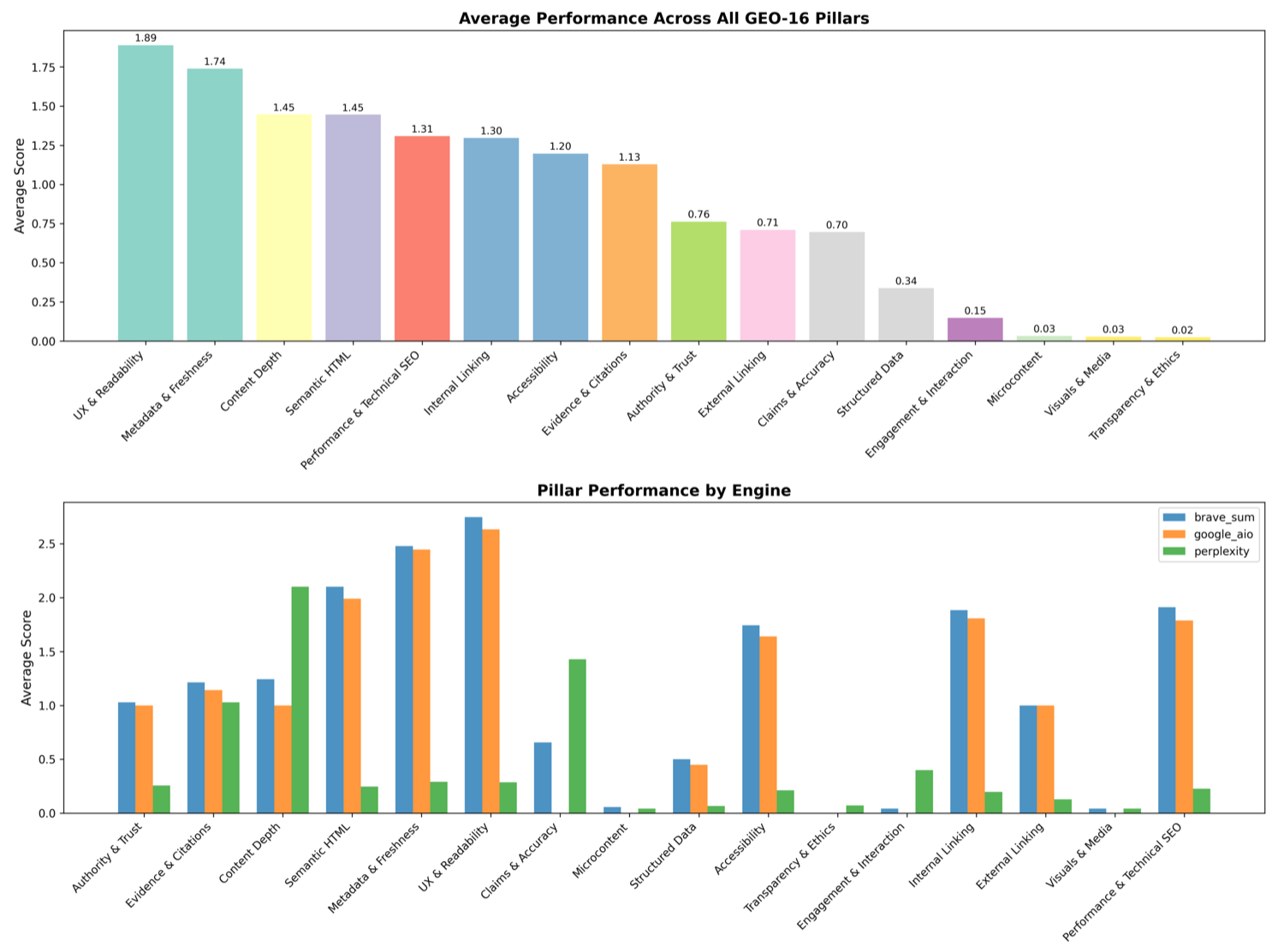
Figure 1. Average score by signal. Readability, metadata, and freshness rank at the top; transparency and media at the bottom.
In other words, the biggest levers are showing both the human-readable publish and update dates and the JSON-LD dates, setting up a single H1 per page with a logical subheading hierarchy, and adding valid schema (Article, FAQPage, and similar). Google also officially documents the role of structured data [3]. Conversely, if the schema doesn’t match the visible content, the effect disappears [1].
What makes a page “well cited”?
The paper offers thresholds for practical use. When the GEO score was 0.70 or higher and 12 or more signals were hits, the citation rate across the three engines jumped to 78%. In logistic regression (Nagelkerke $R^2$ = 0.743), the GEO score’s odds ratio (OR) was 4.2, larger than any other factor [1].
| Criterion | Sensitivity | Specificity | Youden’s J |
|---|---|---|---|
| G ≥ 0.70 | 0.78 | 0.84 | 0.62 |
| Signal hits ≥ 12 | 0.85 | 0.79 | 0.64 |
Table 2. Operating thresholds that separate cited from uncited [1]. Meeting both conditions gives a cross-engine citation rate of 78%.
Notably, URLs cited by two or more engines had quality scores 71% higher than URLs cited by only one engine. Cross-engine citation is a strong signal of quality [1].
Each engine has a different bar
The same page gets treated differently by each engine. Brave was the pickiest, citing only high-quality, well-structured pages, while Perplexity had a low bar and widely cited even poorly structured pages [1].
| Engine | Average GEO | Average signal hits | Citation rate |
|---|---|---|---|
| Brave Summary | 0.727 | 11.6 | 78% |
| Google AI Overviews | 0.687 | 11.0 | 72% |
| Perplexity | 0.300 | 4.8 | 45% |
Table 3. Citation tendencies by engine. Brave and Google heavily reward structure; Perplexity has a low bar [1].
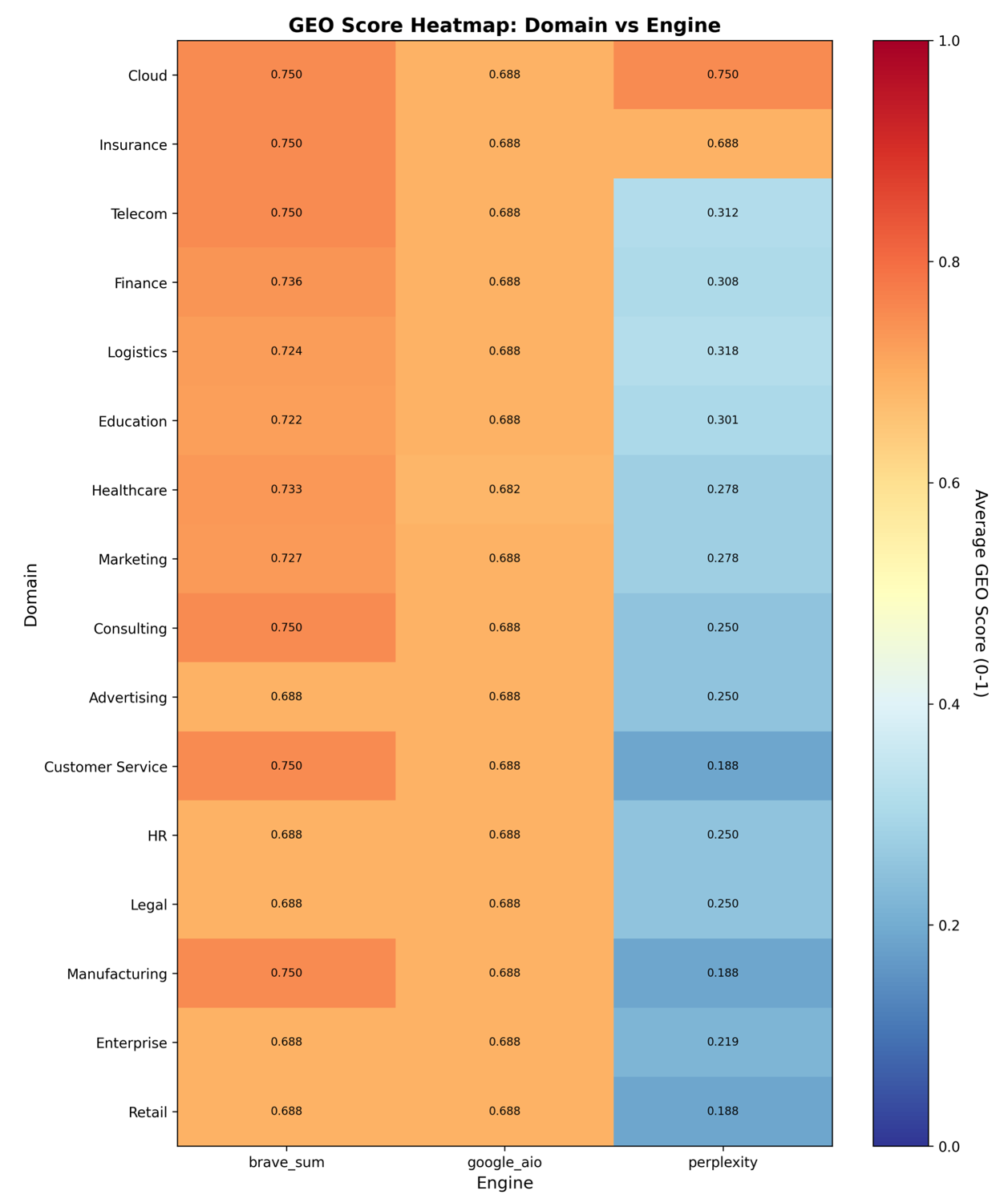
Figure 2. Distribution of GEO scores by domain and engine. Brave consistently shows the highest bar.
So priorities diverge. If you’re targeting Brave and Google AI Overviews, focusing on structure, schema, and freshness has the highest ROI, while Perplexity puts little weight on on-page structure, so structural optimization alone isn’t enough.
Limitations of this study
There’s one thing to keep in mind. This audit is an observational study of English-language B2B SaaS at a single point in time, so it shows correlation, not causation. It also didn’t measure off-page factors like backlinks and brand reputation [1]. In fact, even high-quality pages got weak citations if they lived only on vendor blogs, because generative engines prefer third-party authority domains.
The TRAIL view: manage structure as a score
This study directly supports what we do. The outcome of AEO and GEO is “did AI cite us?”, and TRAIL Search tracks those citations and share of voice (SoV) by engine. Turning the lessons of GEO-16 into a practical checklist looks like this.
- Metadata and freshness first: Show the visible date and the JSON-LD date together, and keep a record of substantive revisions. It’s the axis with the largest contribution.
- Build the structure: Provide machine-readable cues with a single H1, logical subheadings, and valid schema. Keep the schema consistent with the body.
- Pack in evidence: Increase citable units with primary-source citations and statistics.
- Treat each engine differently: Brave and Google reward structure heavily, while for Perplexity, visibility on third-party authority domains is more decisive.
In the end, citation isn’t a vague goal of “good writing”; it’s a problem you can manage by scoring each signal. Read alongside FeatGEO, which automatically optimizes what to include, design and measurement fit together as a pair [4].
For related reading, see Which of two pages will AI cite? The four gatekeepers of competitive citation, Can changing structure alone raise AI citations? Evidence on headings, paragraph length, and document skeletons, and FeatGEO: is it keywords or structure that earns AI citations? Feature-level GEO.
References
- Kumar & Palkhouski, “AI Answer Engine Citation Behavior: The GEO-16 Framework”, arXiv:2509.10762 (2025)
- Aggarwal et al., “GEO: Generative Engine Optimization”, KDD 2024
- Google Search Central, “Structured data and rich results”
- Liu & Xu, “Think Before Writing (FeatGEO)”, ACL 2026
FAQ
What is GEO-16?
It’s a framework that scores whether a page is worth citing by AI answer engines on 16 quality signals (pillars), 0–3 points each, and sums them into a single score G. Machine-readable signals like metadata and freshness, semantic HTML, and structured data are at its core.
Which signals raise citations the most?
In order: metadata and freshness (+47%), semantic HTML (+42%), and structured data (+39%). The priorities are showing both a human-readable date and a JSON-LD date, setting up a single H1 with a logical subheading hierarchy, and adding valid schema.
What score gets a page cited well?
The paper’s operating threshold is G ≥ 0.70 and hits (signals at band 2 or higher) ≥ 12. When both were met, the cross-engine citation rate across the three engines was 78%. In logistic regression, the GEO score had the largest odds ratio (OR) at 4.2.
Do engines differ in their citation tendencies?
Greatly. Brave was the pickiest, with an average GEO of 0.727, citing only high-quality, well-structured pages; Google AI Overviews came next (0.687); and Perplexity, at 0.300, had a much lower bar, citing even poorly structured pages widely.