





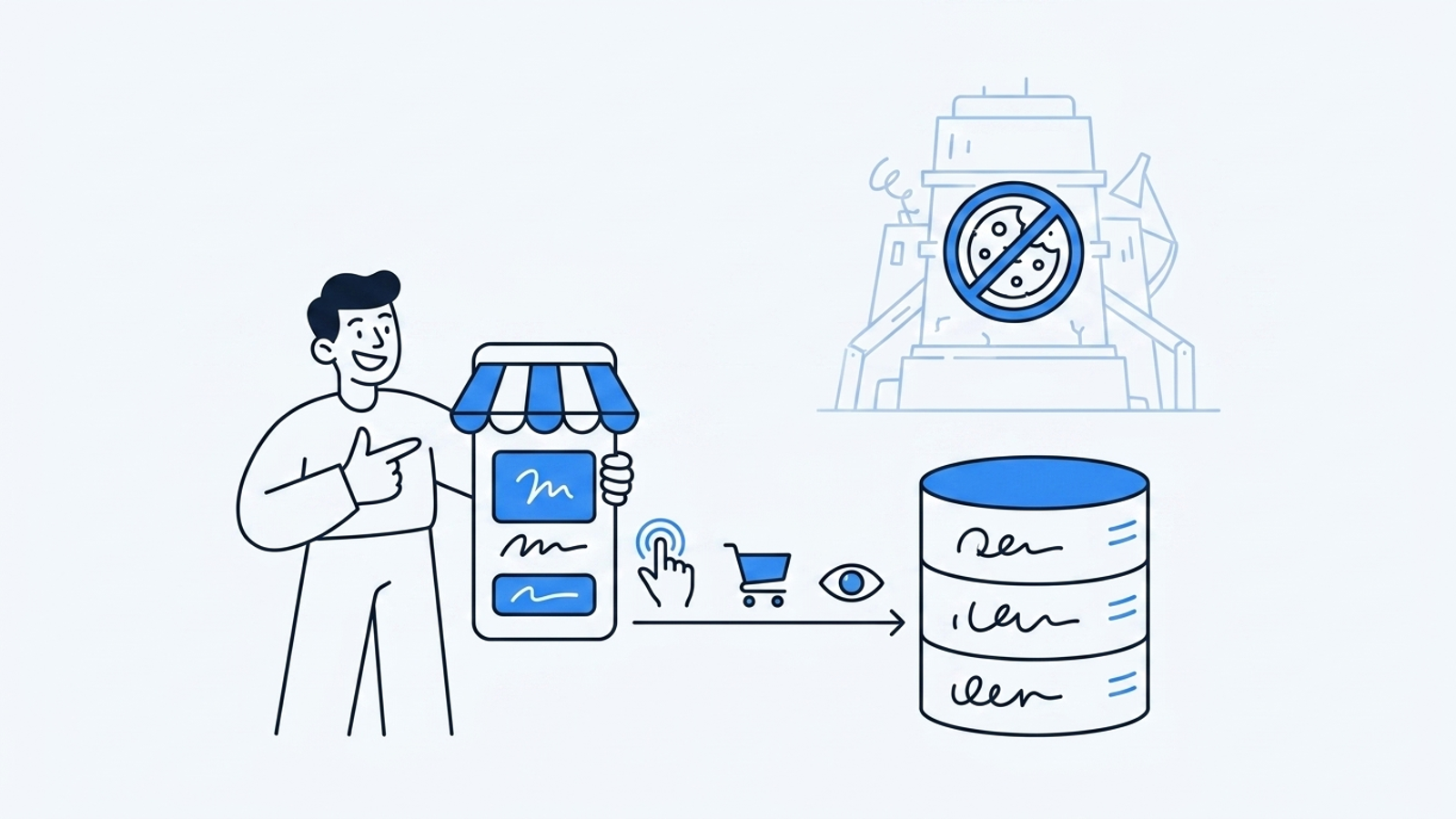
First-party data is the behavioral record customers leave directly on your own site or app, such as views, clicks, and add-to-carts, and unlike third-party data borrowed from outside, it shows customers’ real intent. The era of blasting ads at a broad audience and waiting for traffic is fading. As privacy protections strengthen and tracking gets blocked, marketing’s center of gravity is shifting from “bringing in new customers” to “understanding the customers who’ve already come.” First-party data is at the heart of that shift.
First, let’s look at the difference between the two kinds of data.
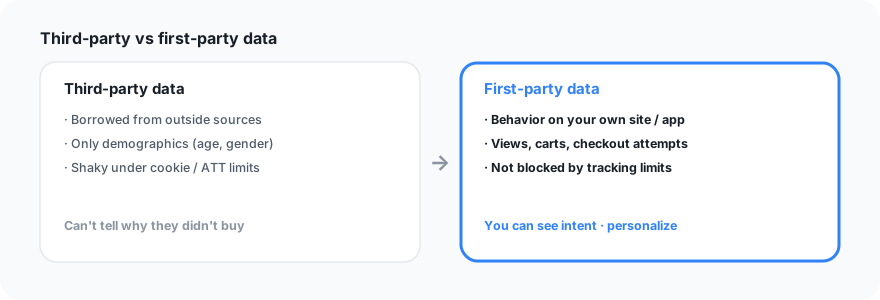
| Type | Source | What it shows | Impact of regulation and tracking restrictions |
|---|---|---|---|
| Third-party data | Purchased from or provided by outside media and data vendors | Demographics such as gender, age, and interests | Heavily affected; depends on browser and OS policies |
| First-party data | Collected directly on your own site and app | Behavioral intent such as views, clicks, add-to-carts, and payment attempts | Barely affected; events inside your own domain |
Third-party data has hit its limits
Third-party data isn’t something you collected yourself; it’s information borrowed from outside media or data vendors. With Safari and Firefox blocking third-party cookie tracking, Chrome changing its policies, and Apple’s ATT (App Tracking Transparency) on top of that, its reliability is wavering.
The more fundamental problem is that it only tells you demographics like gender, age, and interests; it can’t tell you “why this customer didn’t buy.” The global average e-commerce cart abandonment rate is about 70% [1], and third-party data can’t tell you why.
First-party data shows customer intent
First-party data is the behavior customers leave directly on your own site or app. What they viewed, clicked, added to cart, or started to pay for and then stopped: all of it directly reveals customer intent.
For example, if someone lingered on the checkout page and then left, you can see they may have been unhappy with the shipping fee or payment options. And because these are events inside your own domain and app, they aren’t affected by browser tracking restrictions. Used well, personalization can lift revenue by an average of 10–15% [2].
What should marketers do?
You need to change the direction of your strategy: from “maximizing new traffic” to “strengthening existing customer relationships.” Acquiring a new customer costs at least 5 times and as much as 25 times more than retaining an existing one [3].
- Respond to signs of leaving right away: Send the right message based on behaviors like dropping off just before checkout or viewing the same item repeatedly.
- Don’t limit yourself to one channel: Deliver personalized messages via Kakao brand messages, web push, app push, in-app messages, and email.
- Execution over volume: What matters more than the amount of data is the ability to read the customer intent hidden in it in real time and turn it into action.
In short
Marketing is now won less by “how many people did we bring in” and more by “how well did we read the customers who came.” With ad costs rising and targeting accuracy falling, the answer is to build deeper relationships with customers using first-party data, an asset that’s yours alone.
Read customer behavior and respond on-brand. Start with Trail Studio.
For related reading, see Defending against RAG hallucinations: classify the types and know the limits of automated verification, Why your brand tone scatters as marketing tools multiply, and the answer of unified production, and What is MCP (Model Context Protocol)? Connecting tools to your AI assistant.
References
- Baymard Institute, “Cart Abandonment Rate” statistics
- McKinsey, “The value of getting personalization right, or wrong”
- Harvard Business Review, “The Value of Keeping the Right Customers”
FAQ
Where should I start to collect first-party data?
The first step is gathering the behavioral data you already have in one place. Store site and app events (views, add-to-carts, payment attempts) in your own database or a CDP, and start by connecting clear behaviors, like churn signals, to messages.
Is first-party data enough on its own, and what is zero-party data?
Zero-party data is information customers tell you themselves, like survey answers or preference inputs. Combined with first-party data (behavioral records), you learn not just “what they did” but “what they want,” so using both together is ideal.
Do small businesses need a first-party data strategy too?
Businesses without big ad budgets need it even more. Acquiring new customers costs far more than retaining existing ones, so reading and responding to the behavior of customers who’ve already visited gives you better efficiency for your budget.